2 Best Selling Premium Hatchbacks To Get Major Updates: Details


The country's two most popular premium hatchbacks will soon be getting updates that will help them become more popular. Now, if you are wondering which two premium hatchbacks we are talking about, they are the Maruti Suzuki Baleno and the Hyundai i20. Today, we are providing you with all the details of the changes that both of these popular hatchbacks will be getting in the near future.

The current second-generation Maruti Baleno, which was launched back in 2022, is now due for a mid-cycle update. As a result of this, the company has already started working on the facelifted version of this hatchback, and recently its test mule was spotted testing on Indian roads for the first time.
From the spy shots, it has been noted that the overall dimensions and silhouette of this hatchback have remained unchanged. Also, the rear section looks the same as the current model, and the tailgate design also looks to be the same. However, the rear bumper is most likely going to get subtle revisions. The LED tail lamps will also be redesigned.

It has been reported that the biggest changes on the Baleno facelift will be on the front end. The facelifted Baleno is expected to get a redesigned front bumper, a new grille, and revised headlamps. The grille will also be wider and sleeker and come offered with a thin chrome strip which will connect the headlights.
The hatchback will also get a set of new alloy wheels and will retain the integrated turn indicators on the wing mirrors. Overall, the front fascia will look sharper and more modern than the current model.
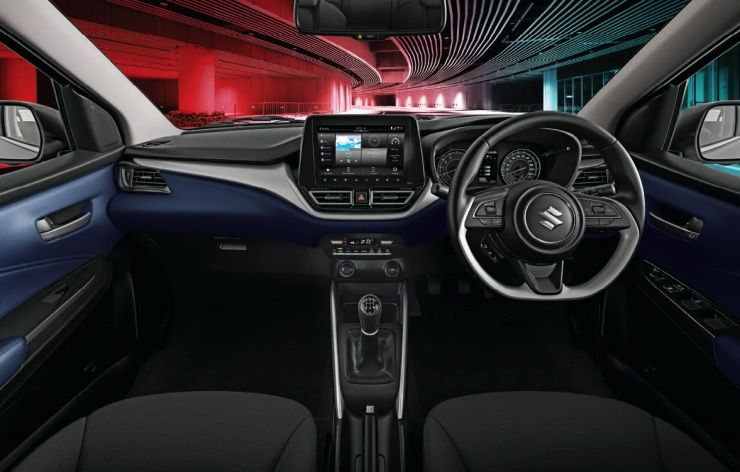
The spy video has also given a sneak peek at the interior of this hatchback. The overall dashboard layout will remain similar to the current model. However, we could see a large freestanding touchscreen in the center. Maruti is expected to offer a new cabin theme, revised upholstery, improved materials, and an updated equipment list.
Reports have suggested that the facelift could also come offered with features such as a fully digital instrument cluster, wireless Apple CarPlay and Android Auto, Alexa integration, a wireless charger, ventilated front seats, a 360-degree camera, and even a sunroof.

Mechanically, the facelifted Baleno will most likely continue to offer the familiar 1.2-litre naturally aspirated DualJet petrol engine. This motor is capable of producing around 90 bhp and 113 Nm of torque. Transmission choices will include a 5-speed manual and AMT automatic.
The CNG version is also expected to continue. It currently produces 76-77.5 bhp and 98.5 Nm of torque and is offered exclusively with a manual gearbox. Reports have suggested that Maruti could also introduce an underbody-mounted CNG tank similar to newer CNG models.

Recently, Hyundai has also launched the new fourth generation of the i20 in Brazil, and it will soon be making its debut in India as well. The new i20 has been changed completely from the outside as well as the inside. At the front, the new-generation model boasts dual-pod pixel-style LED headlights and Y-shaped LED DRLs, which have been connected by a full-width light bar. The bumper has also been redesigned, and it now features a honeycomb-pattern grille and also gets a radar sensor for ADAS Level 2.

The side profile has also been changed, and it now features bigger 17-inch alloy wheels. To add to the unique styling, it now gets thick black cladding around the wheel arches and lower body. The roofline and window design have also been revised. As for the rear, the hatchback now gets connected LED tail lamps, a redesigned tailgate, and a sportier bumper.

The upcoming new-generation i20 will also boast a completely redesigned dashboard, and it will feature dual connected displays. These will include a 10.25-inch digital instrument cluster and a larger 12.3-inch touchscreen infotainment system housed in a single curved panel, as in the new Venue.
It will also come offered with a new steering wheel, a touch-based automatic climate control system, higher-quality materials, updated upholstery, and a more premium overall cabin experience. Features expected on the new model include wireless Apple CarPlay and Android Auto, Bluelink connected car technology, ADAS, ventilated seats, ambient lighting, and several other premium additions.

The next-generation i20 is expected to offer the same 1.2-litre naturally aspirated petrol engine and the 1.0-litre turbo-petrol motor offered on the N-Line. Hyundai is also working on a new 1.2-litre turbo-petrol engine, which could make its way into the hatchback. Most likely, it will be launched by the end of this year or by early next year.