Major Relief For Electric Vehicle Owners: Fire Dept Issues Apartment EV Charger Notification


Just a few weeks ago, it was reported that high-rise societies in Gurgaon and nearby areas were not given Fire NOCs (No Objection Certificates) by the fire department due to the presence of EV chargers in the basements of buildings. Soon after, the societies started ordering EV owners to remove their chargers from the basements. Well, it has now been reported that the Government of Haryana has issued an official notification which will provide major relief for EV owners across the state.

Recently, an official notice from the Revenue and Disaster Management Department, which also oversees the Fire and Emergency Services Department of Haryana, has been released. In this detailed notification, a number of comprehensive fire safety guidelines specifically for EV charging stations across the state have been highlighted.
It has been clearly mentioned in the notification that there is no ban on EV charging in basements. However, high-rise societies’ RWAs (Resident Welfare Associations) and the owners of electric cars which have these chargers installed in basements will have to follow the compliance code provided by the authorities.
In simple terms, this means that EV chargers can remain and can be installed in basements only if the societies and owners follow the prescribed safety norms. This is a major relief, as in just a few days, all EV owners in high-rise societies in Haryana were told to remove EV chargers as soon as possible.
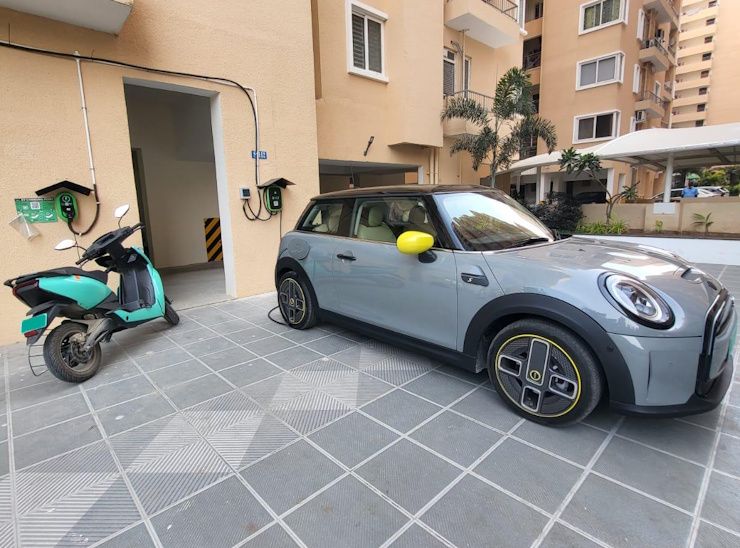
For those who may not be up to speed with what was going on, recently it was reported that the Fire NOCs of over 600 high-rise societies in Gurugram alone were stalled by the Haryana Fire Department due to EV chargers installed in basements. The fire department had classified EV charging as equivalent to fuel dispensing, similar to petrol, diesel, and CNG. All of these made basement charging a major safety hazard.
The official notices earlier highlighted that there are many risks with EV chargers in basements. These included short circuits due to increased electrical load in confined spaces, rapid fire spread due to tightly packed vehicles, and severe smoke accumulation from poor ventilation. The authorities added that, in case of emergencies, it would be very difficult for firefighters and emergency service providers to evacuate buildings and people.
As a result of this, RWAs were instructed to remove existing charging points. The RWA of DLF The Ultima in Sector 81, Gurugram, had even issued a mandatory notice asking EV owners to remove their private chargers within just 7 days.

The new notification now clearly states that EV charging stations and points can be permitted in the first basement level. However, there should be an area for cross ventilation or mechanical ventilation. Also, charging is permitted at ground-floor stilt parking areas, the first podium level, and first-level car parking floors.
Click here to download notification
The notification has also provided very detailed guidelines on safety. These include that all EV charging stations must be designed, installed, tested, and certified in accordance with the Electricity Act and guidelines issued by the Chief Electrical Inspector of Haryana. Also, the charging devices must be certified by a nationally recognised testing laboratory such as NABL.

Apart from these, EVs parked in regular car parking must be segregated from other vehicles. For this, the use of both passive and active fire protection measures has been mentioned in the notification. Additionally, in the basements, the maximum size of the EV parking and charging compartment has been set at 200 square metres.
Active protection measures include water mist sprinkler systems and smart thermal runaway detection systems. Meanwhile, passive measures include fire-rated walls, fire curtains, and smoke curtains. It is also very important to note that EV charging is strictly not permitted in any automated, mechanised, or stacked car parking system.
The notification has also divided EV charging into three categories. These include private, semi-public, and public, and each of them has its own requirements. For private charging, only slow and moderate power chargers have been permitted in building parking areas. Additionally, fire detection, fire alarm, and control systems must be installed by a government-approved licensed agency.

It has also been mentioned that specific fire extinguishers will have to be placed near charging points for every 100 square metres of area. As for semi-public charging in apartment complexes and gated communities, chargers exceeding 11 kW in enclosed areas will require fire-resistance board cladding with a minimum of 2 hours of fire resistance.
An automatic sprinkler system with a sprinkler head above each parking space is also mandatory as per the rules. For public charging, the requirements are the most strict. They will require additional specialised lithium-ion-specific extinguishers. For all categories, existing building owners must install all required systems and get approval from the concerned Fire Station Officer within two months.
An annual maintenance certificate must also be submitted. This particular notification provides a clear and structured framework for EV charging in residential buildings, and this will help all EV owners. It has been mentioned that this notification is currently in draft form, and the government has invited objections and suggestions from the general public within 15 days from 29 April 2026 via email at technical-dfs@hry.gov.in.

This notification, as mentioned above, is a major step in the right direction. Until now, EV owners in high-rise societies in Haryana and nearby areas were stuck in a very difficult situation. Those who had installed private chargers had been asked to remove them immediately, which forced them to rely on shared charging infrastructure.
All of this led to EV owners facing higher costs, longer waiting times, and significant daily inconvenience. Renters were the worst affected, stuck in a three-way deadlock between landlords, RWAs, and unclear regulations. Now, with this notification, once finalised, all stakeholders will get a clear framework. RWAs will also know exactly what they need to do to allow EV charging while maintaining Fire NOC compliance.
Lastly, EV owners will now also know exactly what safety measures are required. Many new EV buyers had already started reconsidering their purchases due to this regulatory confusion. However, now they will most likely go ahead with their purchases to enjoy the benefit of home charging and convenience.