Soon E20, E22, E25 And E30 Petrol To Have Separate Nozzles At Fuel Stations: Fresh Report


We all know that the Government of India is soon going to increase the amount of ethanol blending in petrol. Now, currently, the only choices that vehicle owners have are either to buy the E20 fuel or premium fuel. However, as per the recent reports, after more ethanol blending takes place in the coming period, fuel buyers will be offered the option to choose the type of ethanol-blended fuel they want for their vehicles.
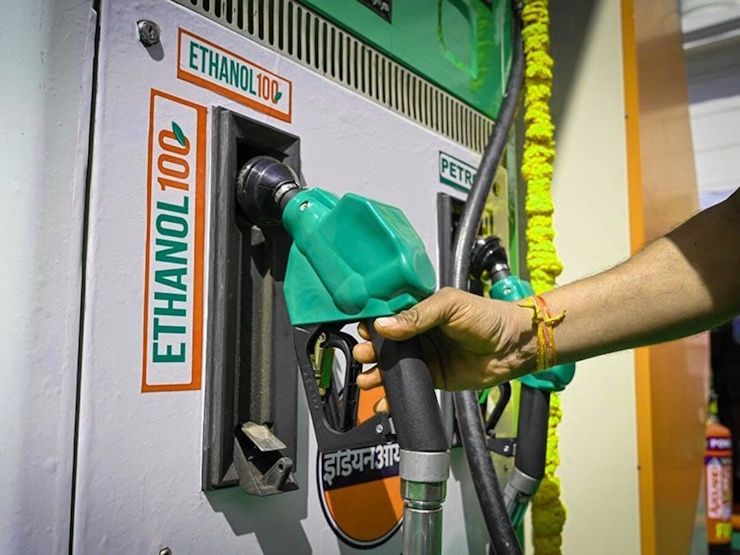
As per the reports, the Government of India has now advised both public and private oil marketing companies to begin preparations for dispensing multiple ethanol-blended petrol variants, including E20, E22, E25, and E30 fuels. Presently, most fuel stations across the country only offer E20 petrol. However, if the new proposal gets implemented, then consumers will be able to select different ethanol blends according to their vehicle compatibility.
It has also been reported that the companies have been advised to begin preparations for the necessary infrastructure required to offer multiple blends of ethanol-blended fuel. These companies include Indian Oil Corporation, Bharat Petroleum Corporation, Hindustan Petroleum Corporation, along with private fuel retailers Jio-bp Mobility, Nayara Energy, and Shell.

As we all know, currently our government is aggressively trying to reduce its dependency on imported crude oil. Presently, India remains the world’s third-largest oil consumer and imports a massive amount of crude oil every year. As per reports, India imported crude oil worth $123.1 billion in FY26. Now, although this number was lower than the previous fiscal year’s $137 billion import bill, the government still wants to reduce dependence on foreign oil even more.
Another major reason behind the push is the ongoing global uncertainty regarding crude oil supply. Currently, the geopolitical situation is very unstable, and reports have highlighted concerns surrounding the Strait of Hormuz, through which around 20 percent of the world’s oil supply passes. And disruption in this region because of the ongoing West Asia conflict has led to massive fuel price volatility globally.
As a result of this, India is now focusing heavily on ethanol blending and alternative fuels for energy security. Apart from reducing oil imports, the government also states that ethanol blending has already delivered massive economic and environmental benefits. According to data released by the Government of India, ethanol blending has helped India save Rs 1.7 trillion between November 2014 and February 2026.
It was also reported that carbon emissions were reduced by nearly 87 million tonnes, which is said to be equivalent to planting around 350 million trees. In the ethanol supply year 2024-25 alone, India reportedly saved over Rs 40,000 crore by replacing imported crude oil with ethanol. These numbers are one of the main reasons why the government is now considering moving beyond the current E20 blending target.

In order to offer multiple ethanol variants, fuel stations across India will need a number of upgrades. The retail outlets will require separate dispensing infrastructure, underground storage systems, blending controls, and fuel quality monitoring mechanisms. Additionally, pumps will also have to clearly display the ethanol percentage of the fuel being sold.
It has been reported that customers should be able to easily identify the correct fuel suitable for their vehicles. Due to this, pumps will soon get separate labels for E20, E22, E25, and E30 petrol variants. At first, it may seem complicated; however, industry experts have stated that the required changes may not be extremely difficult to implement.
K.P. Murali, president of the Tamil Nadu Petroleum Dealers' Association, stated that oil companies would bear the cost of installing additional tankages and dispensers. He also mentioned that existing storage systems could be adapted for higher ethanol blends.
Meanwhile, Prashant Sinha, a fuel station operator from Patna, explained that fuel dispensers already handle multiple fuel types, including diesel, premium petrol, and regular E20 petrol. Because of this, the same dispensing setup can be expanded further for additional ethanol variants between E22 and E30.

One of the biggest changes for fuel buyers will be the pricing difference between various ethanol blends. Reports have suggested that different variants are likely to carry different prices. With this, consumers will eventually choose fuel not only according to vehicle compatibility but also depending on fuel prices.
Presently, the exact pricing strategy has not been revealed. However, it is expected that ethanol economics, crude oil prices, and production costs will play a major role in finalizing the retail price of each blend. Some reports have stated that the fuel could become more expensive or less expensive depending upon the amount of ethanol blended.

The proposal for higher ethanol blending has once again caused the public to question the mileage, engine reliability, and performance of their vehicles. A number of consumers over the last few months have raised concerns that higher ethanol blends reduce fuel efficiency and negatively affect engines not designed for such fuels.
However, the government, on multiple occasions, has stated that E20 petrol improves acceleration and ride quality. Authorities have also dismissed claims suggesting a drastic reduction in fuel efficiency due to ethanol blending. At present, newer vehicles are already being designed to support E20 petrol. But in the near future, automakers will also begin preparing engines compatible with E25 and E30 fuels if the government officially introduces these variants in the market.

Another major reason why the Government of India is focusing towards higher ethanol blends is the increasing ethanol production capacity in the country. Reports have suggested that India had already produced around 20 billion litres of ethanol by March 2026.
Meanwhile, the estimated demand under the current 20 percent blending programme stands at around 11 billion litres. This means that India currently has surplus ethanol production capacity. Due to this, ethanol manufacturers and industry bodies have been strongly advocating for fuel blends beyond E20.
C.K. Jain, president of the Grain Ethanol Manufacturers Association, has also highlighted that countries like Brazil have successfully managed to adopt higher ethanol blends. This has been done using separate dispensing systems and flexible consumer choices. He added that eventually India could also offer multiple ethanol variants depending on regional demand, infrastructure readiness, and vehicle compatibility.