CAFE 3 Enters The Hard Phase As Gadkari Calls Out Carmaker Pressure


Nitin Gadkari has dragged a closed-door policy fight into the open. This could have a big bearing on CAFE 3. This is because it is not some abstract rulebook change. It will shape what kinds of cars companies build from April 2027, how much fuel those cars use, and how much more buyers may have to pay to meet the next round of efficiency targets.

Gadkari has now said the proposed CAFE 3 norms will be reviewed within 15 days, while also making it clear that the government is not blind to the lobbying that has surrounded the draft.
The current CAFE 2 regime already sets a fleet-wide average carbon dioxide limit of 113 grams per km for passenger vehicles under 3,500 kg, and it stays in place till March 2027.
The next phase is where the disagreement begins. Earlier drafts and policy discussions pointed to a much sharper tightening path under CAFE 3, with one set of proposals moving toward 71.5 grams per km by 2032, while the auto industry argued for an easier path closer to 89.6 grams per km over the same period.

That gap is the whole story. Carmakers are not fighting over principle here. They are fighting over cost. A steeper target means more hybrids, more EVs, lighter vehicles, better aerodynamics, stronger engines, more expensive components, and more engineering spend across the fleet. A softer target gives companies more time to stretch existing petrol, diesel and CNG products, which is why the pressure on the final draft has been so intense.
Moving from the current 113 g/km limit to 71.5 g/km would mean a cut of about 41.5 g/km, or roughly 36.7 percent. The industry-backed path to 89.6 g/km would still be tighter than today, but the reduction would be about 23.4 g/km, or around 20.7 percent. In other words, the tougher line demands almost twice the improvement of the softer one. That is a huge spread for companies planning products, engines and investments several years in advance.
The difference between those two end-points is 18.1 g/km. On paper that may not sound dramatic. In the real world, it can decide whether a manufacturer can survive with a largely petrol-heavy line-up or must accelerate hybrids and EVs much faster. It can also decide whether small cars remain relatively affordable or start absorbing the cost of compliance hardware that buyers may not directly see but will still have to pay for.
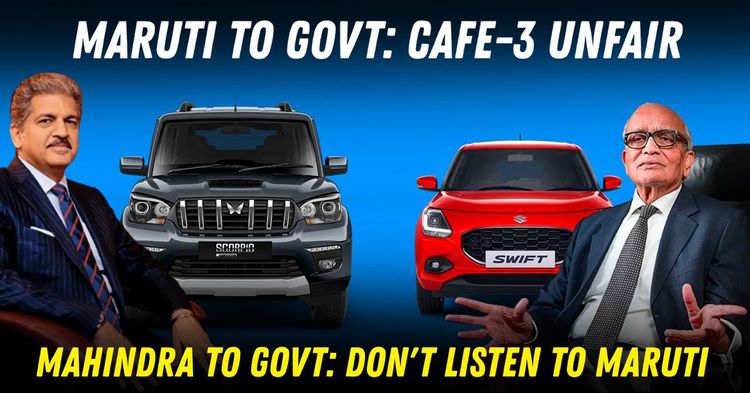
The divide inside the industry is also not hard to read. Small car-heavy players have been seeking relief for lighter, lower-priced cars, while larger vehicle makers have pushed for a cleaner, more uniform formula instead of extra carve-outs.
Earlier consultations also showed another split over how EVs should be counted and whether flex-fuel vehicles should get treatment closer to electric vehicles in the compliance math. Gadkari himself has spoken in favour of a more technology-neutral approach that does not create too wide a gap between EVs and flex-fuel vehicles.
For buyers, the outcome will show up in price tags. If the final rules stay very tight, manufacturers will have to recover compliance costs somewhere, and that usually means either higher prices or a push toward more expensive powertrains.
If the rules are softened too much, the short-term benefit will be a smaller hit to showroom prices, but the long-term loss will be slower improvement in real-world fuel efficiency and lower pressure on companies to modernise their mass-market line-ups.

There is also a second layer to this fight that Gadkari does not seem willing to ignore. He has repeatedly tied the fuel-efficiency debate not just to pollution, but also to import dependence, running costs and support for agriculture through ethanol-linked flex-fuel programmes.
That gives the policy a much wider frame than a normal auto regulation. It also explains why the government is trying to balance EVs, hybrids, flex-fuel vehicles and conventional internal combustion models inside the same future roadmap.
Calling EVs and flex-fuel vehicles closer together in policy language is one thing. Building a clean, workable compliance formula around them is much harder. EVs count as zero tailpipe-emission vehicles today, while flex-fuel cars still emit at the exhaust even if they serve a domestic energy and farm-economy objective. That is why the final wording of CAFE 3 will matter.