Compact Sub-4 Meter Sedan Sales Growing: Full Size Sedan Sales Tanking


The April 2026 sedan sales data tells a story in two halves. The compact sub-4 metre sedan category, led by the Maruti Suzuki Dzire, Honda Amaze, and Hyundai Aura, is growing sharply. The full-size sedan category, which includes the Hyundai Verna, Skoda Slavia, Volkswagen Virtus, and Honda City, is contracting just as sharply. The divergence is acute. The primary engine behind compact sedan growth is not private buyers. It is the taxi and cab aggregator market.

The Dzire sold 23,580 units in April 2026, up 38.7 percent from 16,996 units in April 2025. It accounted for 67 percent of the entire sedan segment's volume of 35,218 units.
The Honda Amaze posted 2,856 units, up 41.5 percent year-on-year. The Hyundai Aura sold 4,587 units, up 8.6 percent.

All three sub-4 metre compact sedans grew. Collectively, they added roughly 6,800 units over their April 2025 combined total.
The Dzire and Amaze are the default CNG sedan choices for Ola, Uber, and state-run cab fleets. Both offer factory-fitted CNG options, which reduce running costs significantly for high-mileage commercial use. The Dzire CNG delivers 33.73 km per kg on the ARAI cycle.
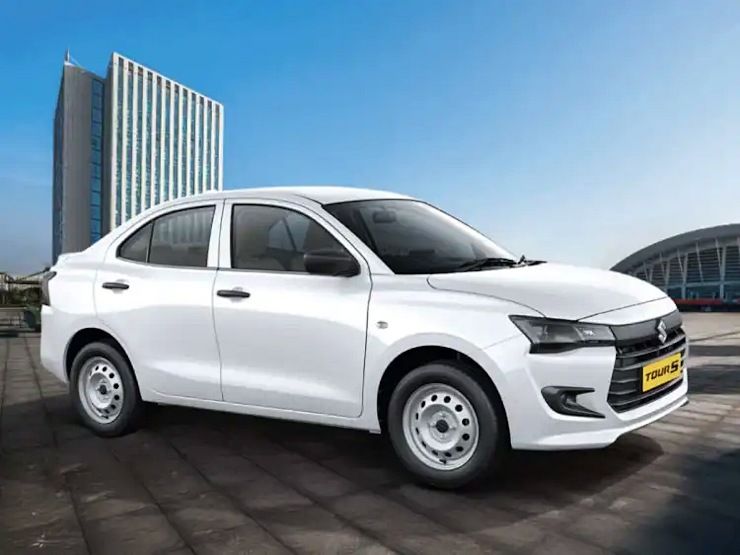
At CNG pump prices of approximately Rs 75 to Rs 85 per kg depending on city, this works out to a running cost well under Rs 3 per km, compared to Rs 6 to Rs 7 per km for a petrol-powered alternative. For a cab driver covering 200 to 250 km per day, that difference is material.
The CNG variants of both the Dzire and Amaze have consistently accounted for 40 to 50 percent of their respective monthly volumes, a proportion that reflects the fleet composition of their buyers. The Aura similarly has a strong CNG following, particularly in north India where the CNG distribution network is densest.
The Dzire also became the best-selling car across all segments in April 2026, beating every SUV on the chart including the Tata Punch (19,107 units) and the Hyundai Creta (15,291 units). For the full year FY2026, the Dzire recorded 2,29,130 units, up 38.8 percent over FY2025, the highest growth rate of any volume model in the country. That is a taxi-driven volume story at its core.

The numbers on the other side of the table are uniformly grim. The Hyundai Verna sold 865 units in April 2026, down 13.9 percent from April 2025. The Skoda Slavia fell 20.8 percent to 830 units.

The Volkswagen Virtus dropped 27.6 percent to 1,162 units. The Honda City collapsed 56.4 percent to just 177 units, its sharpest year-on-year decline in recent memory.

Honda's City numbers, in particular, reflect the imminent facelift effect: buyers who know the updated model is coming on May 22 are holding off from the current car.
For the full year FY2026, the Verna sold 9,925 units, down 36.3 percent from FY2025. The City sold 7,142 units, down 34.5 percent. The Tigor, Tata's entry into this space, dropped 26.4 percent to 12,147 units over the year. These numbers represent a sustained structural decline in private buyer interest for sedans priced above Rs 11 lakh.
The full-size sedan occupies an awkward price band. At Rs 11 to Rs 18 lakh, the Verna, Virtus, Slavia, and City are competing against compact SUVs, which offer more visual presence, higher seating position, more boot space, and broadly comparable fuel efficiency.

The Hyundai Creta, Maruti Suzuki Grand Vitara, Kia Seltos, and Tata Nexon all compete for the same wallet. For a private buyer making a considered purchase, the sedan no longer has a decisive advantage in ride comfort, fuel economy, or features that it held a decade ago.
The segment's survival, in volume terms, depends entirely on the sub-4 metre cars and their relationship with commercial fleets. Without the taxi market, the sedan category would be a fraction of its current size.