

Over the last few months, we have all been noting the push for High Security Registration Plates (HSRP) from the Government of India. Now, a lot of people think that HSRP is being promoted to help with the problem of car theft and standardization. However, the real reasons behind it are different. Today, we will be telling you the actual reasons why the Government of India is pushing HSRP so hard on all vehicle owners across the country.

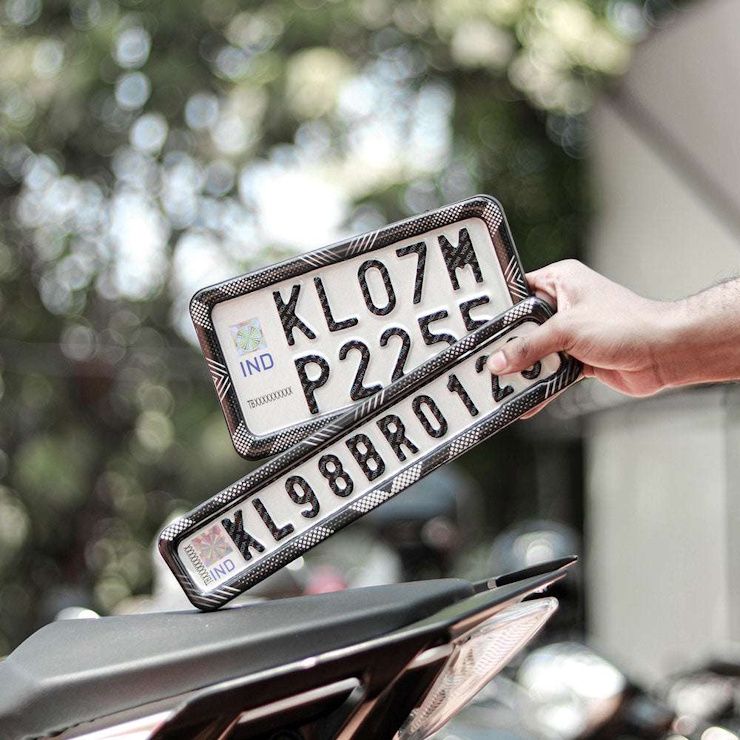
Before understanding the main reasons behind the push of high-security registration plates on Indian vehicle owners, we have to understand what HSRP actually is. For those who may still be living under a rock, HSRP is the standardized number plate that has been mandated across the country. It is made of aluminium and has a chromium-based hologram.
Also, it comes with a laser-etched permanent identification number and a snap-lock mechanism, which, as per the government, is tamper-proof. These number plates are directly linked to the vehicle chassis number, engine number, owner details, and the VAHAN database, which has all the other crucial information of the vehicle owner.

The first and the main reason behind the active promotion of HSRP is to make sure there is a smooth transition into barrier-less FASTag toll collection. Just a few days ago, we shared the news of India’s first barrier-less FASTag toll here on Cartoq as well. See, the government wants to move from traditional toll booths and barriers, where people have to wait and pay with FASTag.
Now, the government is planning to introduce Multi-Lane Free Flow (MLFF) toll systems. The first trial of this system took place on the NH48 near Surat, Gujarat. What happens in this type of toll collection system is that cameras, sensors, and RFID readers quickly detect a vehicle and deduct the toll automatically without the vehicle stopping.
So, to make sure that this happens smoothly, all cars, bikes, and other vehicles will need active FASTags and HSRP. The barrier-less system will mainly rely on FASTag RFID. However, if FASTag collection fails, the Automatic Number Plate Recognition (ANPR) will read the number plate, and the VAHAN database will be checked. Following this, the challan will be deducted and a violation will be issued. So, basically, HSRP is required to make sure that the barrier-less toll collection works reliably.
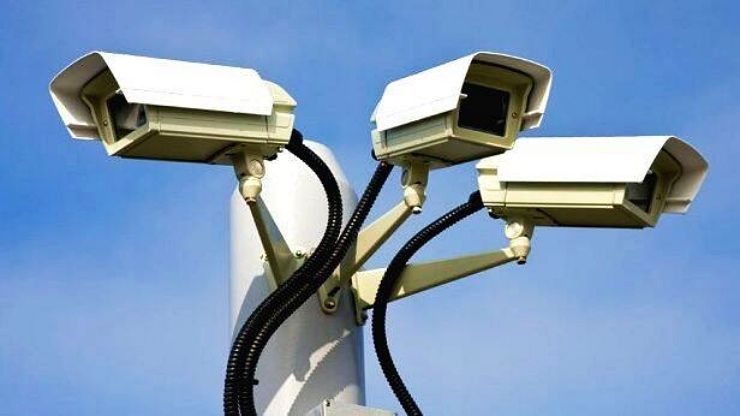
Coming to the second big reason behind the HSRP push, it is that the government wants to quickly move towards automatic enforcement with the help of smart cameras, sensors, machine learning, and licence plate recognition using HSRP. The government wants to detect violations such as speeding, red-light jumps, wrong-side driving, lane violations, and helmet and seatbelt violations.
What will happen is that the cameras will quickly be able to scan the HSRP and automatically generate e-challans and send fines directly to the owners. The main advantages for the authorities will be that the AI-based system works 24/7, without human intervention, and with real-time processing. This will then directly result in higher violation detection rates, faster challan generation, and fewer disputes with the local authorities.

Now, as the HSRP helps in quickly matching the details of the vehicle, vehicle owner, insurance, FASTag, PUC, and other crucial information, it will help the government in tracking movement, flagging violations, and also identifying stolen vehicles. Additionally, HSRP will also help in monitoring suspicious activities and locating and identifying vehicles linked to criminal cases, hit-and-run incidents, terror threats, and smuggling.
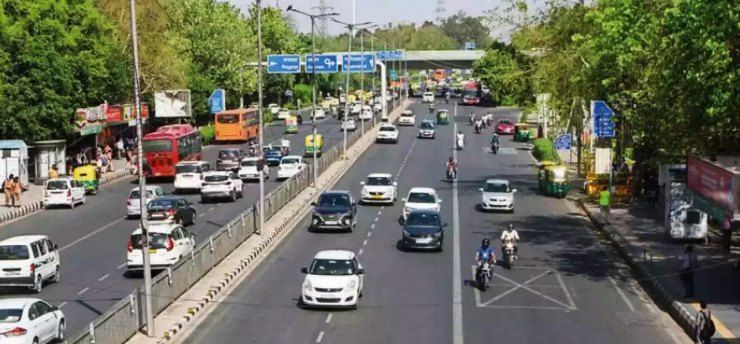
On top of these, HSRP will also enable geo-fencing, where the authorities will be able to monitor entry into sensitive zones, city centres, and pollution-restricted areas. Lastly, it will also help in instantly blacklisting stolen vehicles, wanted vehicles, and repeat offenders. So, basically, pushing HSRP will help the government in making large-scale digital enforcement and tracking better and more effective.
It seems like the government is heading towards a brighter future when it comes to overall enforcement of rules and regulations on all vehicle owners. All of the above motives will push vehicle owners in India to be more responsible and accountable for their actions and make them aware that, from now on, they won’t be able to escape the consequences of their violations with a slap on the wrist.