Cricket Icon Jonty Rhodes Highlights Delhi's Poor Air Quality During Transit


Former South African cricketer Jonty Rhodes has drawn attention to Delhi’s worsening air pollution after a brief stopover in the city earlier this week. The 56-year-old, who lives in a coastal village in South Goa, shared his concern on social media about the air quality he encountered while travelling to Ranchi.
Rhodes, known for his long association with cricket in the subcontinent, posted on X that it was “hard to digest the low levels of air quality” in Delhi. He added that he was thankful to live in Goa, where the air is far cleaner. His post, tagged #AQI and #whats2Bdone, came as Delhi recorded some of the season’s worst pollution levels.
According to the Central Pollution Control Board (CPCB), the city’s average Air Quality Index (AQI) on Sunday was 391, categorised as “very poor.” It briefly improved to 370 by the afternoon and 365 by evening. By Monday morning, it had dropped to 346, which still posed a serious health risk, especially for children and the elderly.

Several monitoring stations in the capital showed even higher readings. Punjabi Bagh topped the list at 425, followed by Bawana at 410, Jahangirpuri at 401, and both Nehru Nagar and Wazirpur at 400. Neighbouring cities [Noida, Ghaziabad and Greater Noida] also reported “very poor” air, with AQI readings over 300.
As per CPCB norms, AQI between 301 and 400 is “very poor,” and anything between 401 and 500 is “severe.” Air quality from 0 to 50 is “good,” 51 to 100 “satisfactory,” 101 to 200 “moderate,” and 201 to 300 “poor.”
The worsening situation triggered a public protest at India Gate on Sunday. Families gathered with children wearing masks and holding placards reading “Help us breathe” and “I miss breathing.” Environmental activist Bhavreen Khandari, speaking at the event, said one in three children already suffers from lung damage, which could shorten their lifespan by nearly a decade.
Police detained several protesters, citing the absence of prior permission. Videos of peaceful demonstrators being escorted away quickly spread on social media, drawing criticism of the authorities’ handling of the situation. Many users commented that clean air should be treated as a fundamental right, not a law-and-order concern.
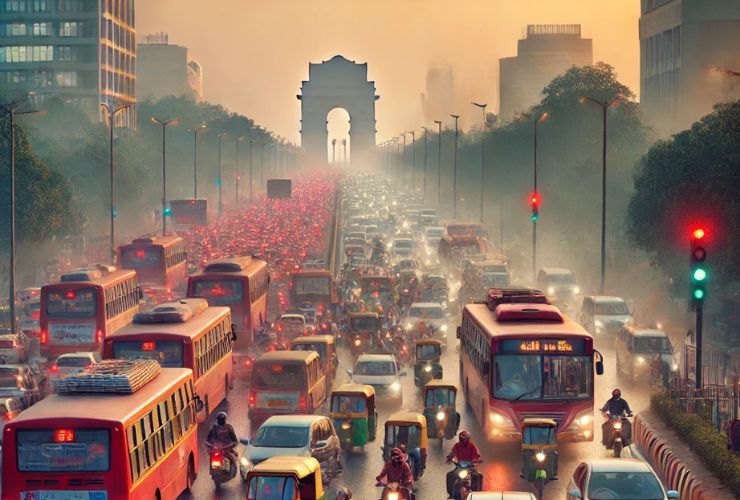
Despite high pollution levels, the Commission for Air Quality Management (CAQM) did not impose Stage 3 restrictions under the Graded Response Action Plan. Officials said the air quality showed a slight improvement and was expected to stay in the “very poor” range, avoiding the “severe” bracket. Stage 3 restrictions would have led to construction bans, suspension of mining operations, and curbs on BS-III petrol and BS-IV diesel vehicles across the National Capital Region.
Pollution control agencies attributed the small improvement to faster winds and better ventilation, which helped disperse pollutants. However, meteorologists from the India Meteorological Department and the Indian Institute of Tropical Meteorology warned that the situation could worsen again if wind speeds drop.
Authorities credited “timely action ”[such as intensified road cleaning, dust control, anti-smog measures, and tighter checks on vehicles and factories] for preventing more severe deterioration. They noted that six of the past seven days recorded better air quality than the same period last year. Typical of the officialdom that is more focused on managing news than actually solving the problem.
Delhi’s air quality typically worsens in November due to a mix of vehicle emissions, industrial activity, and stubble burning in neighbouring states. The pollution often peaks around Diwali when fireworks add to the problem.
Rhodes’ post, showing the contrast between smoggy Delhi and clear skies in Goa, struck a chord with many. For the cricketer, who has made India his second home for several years, the experience was a reminder of how uneven environmental conditions remain across the country.
The message was simple but telling: while some parts of India breathe easy, others are still gasping for air.