

On one hand, the government of India is pushing car buyers to buy electric cars to curb increasing pollution levels and reduce dependence on crude oil imports. However, those who have actually bought electric cars are now facing a lot of inconvenience due to ever-changing rules and regulations around home charging. Recently, three such cases have been shared online in which EV owners have highlighted how they are being stopped by the RWAs (Resident Welfare Associations) from installing EV chargers in housing societies/apartment complexes.
The most recent case has been shared on X by Nitin Sinha. In his post, Sinha shared an image of a Mahindra XEV 9E parked in a basement. He mentions that this particular Rs 20+ lakh vehicle was bought three months ago; however, as the owner of this car is renting the flat in which he lives, the housing society has refused to give him permission to install a charger in the basement where the vehicle gets parked.
In the same post, Sinha highlighted that the person bought this particular electric car thinking that he would be able to charge it at his home, which would help him in saving fuel cost and time. However, as the society is not allowing him to install a wall charger, he is now be forced to use public chargers, which will increase the cost of charging. Also, there's the inconvenience of leaving the vehicle unattended for a long time.

The crux of this particular post, according to the person who has shared this is that, on one hand, the government is actively promoting EVs and is also making rules for housing to let EV owners install chargers at their homes.
However, on the other hand, actual EV owners are getting affected by the strict rules of RWAs, and also because of the disconnect between the Government's guidelines and various statutory authorities.
It has also been mentioned that the situation is still at some level of control for a person owning an EV who owns the flat in which he resides. As the owner can raise the issue at society meetings and push for approvals in the AGM (Annual General Meeting) and also negotiate with the RWA members.
However, if a person is renting a flat in a society, he is stuck in a three-way deadlock. What happens is that the landlord often refuses charger installation due to higher electric usage and billing complications.
On the other hand, the RWA becomes hesitant due to safety, compliance, and liability concerns. And lastly, the regulations also don't help him because of the unclear and inconsistent enforcement.
Lalit Verma, FSO, Fire Station Manesar, was quoted by Jagran saying this,
“Societies with EV charging points in their basements have been objected to on their fire NOCs and asked to remove the chargers, as they are unsafe.”
And this issue is not limited to Gurugram. Electric car owners in one of India's biggest EV markets - Bengaluru - are also facing similar issues,
In addition to the issue of EV owners living on rent, there is a separate issue which is now being reported from housing societies across Gurugram. It has been reported that fire NOCs (No Objection Certificates) for over 600 high-rise societies have been stalled by the fire department. And the reason is not EVs themselves. Rather, it is about how charging points have been installed in the basements of the buildings.
The fire department has highlighted that the installation of chargers in the basements of housing can cause short circuits and major fires in enclosed basement spaces. It added that if a fire erupts in the basement, it could rapidly spread due to tightly packed cars in the parking area.

Also, poor ventilation can lead to smoke accumulation, and lastly, it would become very difficult for firefighters and fire trucks to access the basement and safely execute evacuation. The fire department also emphasized that basements with pillar-mounted chargers are being seen as high-risk zones, particularly because they combine electrical load with confined space.
In Seoul, South Korea, an EV explosion that originated from a Mercedes Benz EQS caused a big blaze that rapidly spread to cars parked in the basement, making an entire residential building block uninhabitable. Over 23 people were injured.
Due to such incidents, the fear factor remains high. Authorities have taken a strict stance where societies with such setups are being denied or stripped of fire NOCs. Additionally, the RWAs are being instructed to remove existing charging points from basements.
Unfortunately, this move is causing a direct impact on EV owners, as they are facing a lot of inconvenience. EV owners are now forced to step out of their societies to charge, which has become very time-consuming, less convenient, and more expensive. Also, many residents are reporting waiting times even for shared charging setups, and as a result, their daily usage planning is getting disrupted.
As a result of the fire NOCs being at risk, RWAs are now actively asking EV owners to remove their chargers. And to make sure that owners get some help, new charging setups are being shifted to ground-level parking areas and open-air common zones. Some RWAs are also partnering with charging service providers and setting up centralised, shared charging stations.
However, EV owners will have to live with compromises, including a limited number of chargers, queue-based usage, and loss of personal charging convenience.
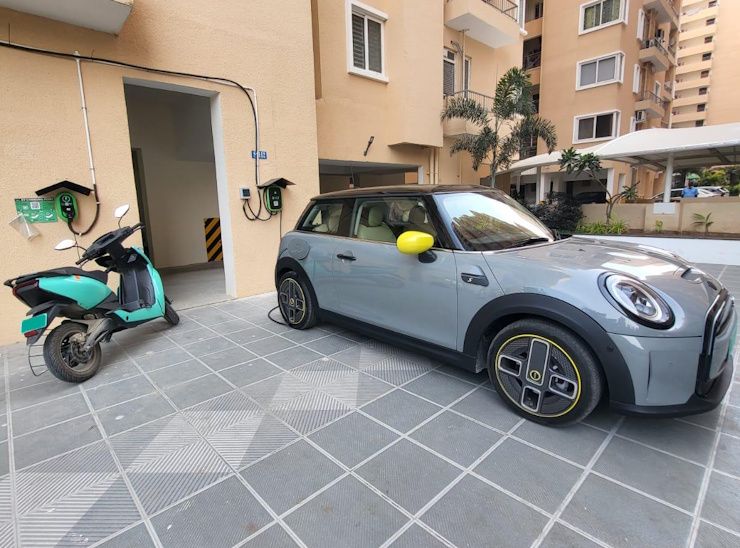
Many large societies already have 10 to 20 EVs on average, and this number is expected to rise significantly in the coming years. This means that the current infrastructure and regulatory confusion will get worse as EV adoption increases. Also, the impact is not limited to central Gurugram.
In Manesar as well, multiple high-rise societies have already faced objections to fire NOCs and orders to remove basement chargers. Many residents in these areas have stated that they are struggling with daily charging needs and are facing uncertainty over long-term EV usability, and also new buyers are confused.
Many new EV buyers are now reconsidering their purchases due to the lack of clarity around charging permissions, society rules, and fire safety approvals. Experts are warning that without standardized and safe charging infrastructure, EV adoption in urban India could slow down significantly.